
spokane living ·
How to keep a clean house with a busy family in Spokane
How to keep a clean house with a busy family: the small Spokane-tested systems that hold up through school nights, sports seasons, mud, dust, and pets.
By Frontline Housekeeping Plus

Anyone asking how to keep a clean house with a busy family has usually already tried the obvious answer, which is to clean more. It does not work, and it is not a discipline problem. A household with two working adults, school pickup, practice three nights a week, and a dog that has opinions about the back door generates mess faster than any Saturday can absorb. We have been in a lot of Spokane homes since 2002, and the ones that stay livable are not the ones with the most energy. They are the ones where the house does some of the work on its own, through a handful of small systems nobody has to think about.
This is not a post about a perfect house. Perfect is not the goal and it is not available. The goal is a home that resets easily, does not embarrass you when someone stops by, and does not eat your weekend. Here is what actually holds up in a real Spokane family home through a school year, a sports season, and whatever the weather is doing.
Change the goal first
Most family cleaning plans fail on the first bad week, because they are built for the version of your life where nothing goes wrong. Something always goes wrong. A kid gets sick, a work trip lands, the car needs a shop day, and by Thursday the plan is a source of guilt instead of help.
A better target is reset speed. How long does it take, from where the house is right now, to get the main living areas presentable? If the answer is fifteen minutes, you have a functioning house even on your worst week. If the answer is three hours, no schedule will save you, because you will never have three hours.
Everything below is aimed at that one number.
Stop the mess at the door
In Spokane, more of the house’s dirt comes through the entry than anything else, and the seasons just change what kind. Winter brings snowmelt, sand, and de-icer that leave a white haze on floors. Spring brings mud. Summer brings dust, grass, and lawn clippings, plus a smoke-season film on everything near an open door. Fall brings leaves and the first wet boots.
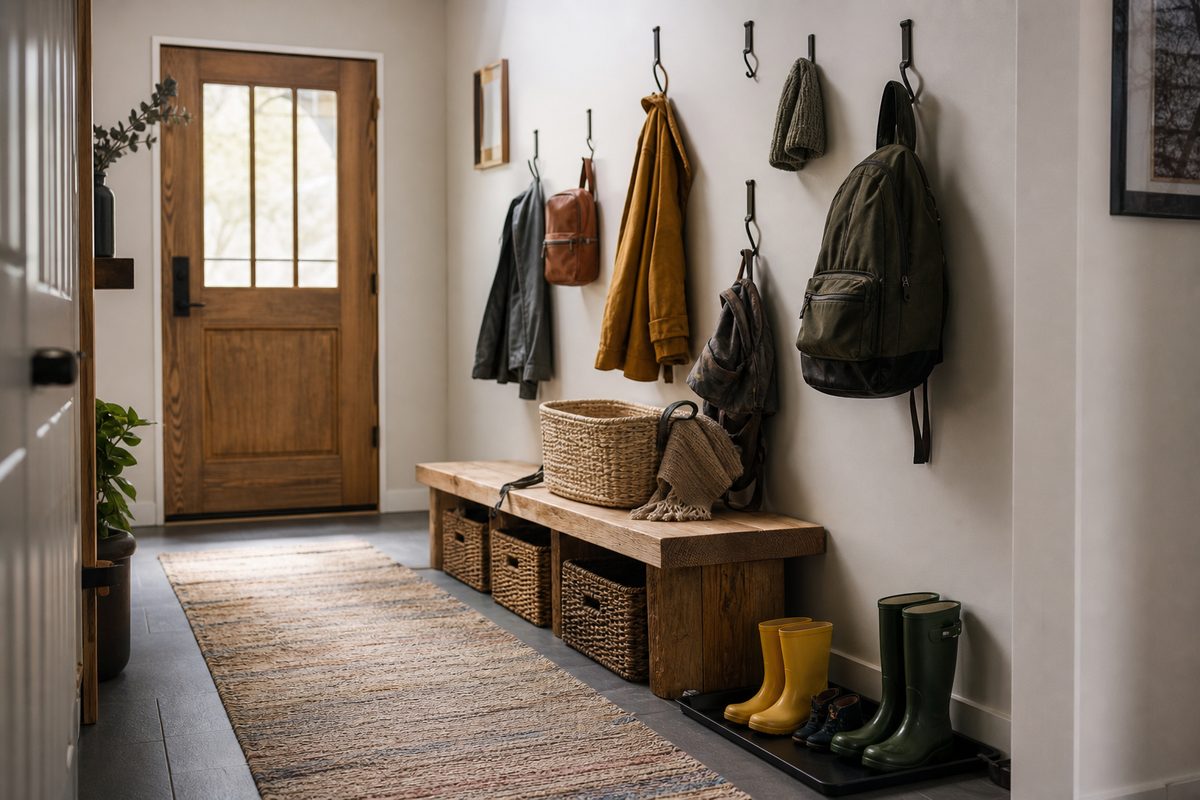
Build the drop zone at the door your family actually uses, which for most Spokane houses is the garage door or the back door, not the front one nobody touches.
- A serious mat outside and a washable runner inside. Most of the grit is captured in the first few steps if there is something there to capture it.
- A boot tray with a lip. Snowmelt and de-icer need somewhere to go that is not your floor. Wipe it out weekly in winter.
- A hook per person, at their height. Backpacks and coats end up on the floor when the hook is a reach.
- One bin per person. Shoes, sports gear, the water bottle that lives in the car. Not a shared bin, which becomes a pile.
- A basket for the stuff that goes back out. Library books, returns, the thing for grandma. It leaves the house on the next trip instead of settling.
If you build only one system from this entire post, build this one. Our guide to winter mud, snow, and salt goes deeper on the floor damage de-icer causes and how to stay ahead of it.
The fifteen-minute family reset
The single most effective habit we see in busy Spokane households is a short, loud, everybody-participates reset at a fixed time. Usually after dinner, sometimes right before bed.
It works for reasons that have nothing to do with cleaning. It is short enough that nobody negotiates. It happens at the same time daily, so it stops being a decision. And because everyone participates, the person who does the most cleaning stops being the only person who sees the mess.
Keep the scope narrow: everything goes back to where it lives, counters clear, dishes in the dishwasher, one lap with a laundry basket for anything upstairs that ended up downstairs. Not scrubbing. Just returning the house to neutral so tomorrow starts from zero instead of from Wednesday.
Give every room one surface that stays clear
Rooms do not read as messy because of dirt. They read as messy because of horizontal surfaces covered in objects. Choose one surface per room that is never allowed to collect: the kitchen island, the dining table, the coffee table, the entry bench.
Everything else in the room can be imperfect and the room will still look fine. This is the highest-leverage rule in a family house, because it is one decision applied over and over instead of a chore.
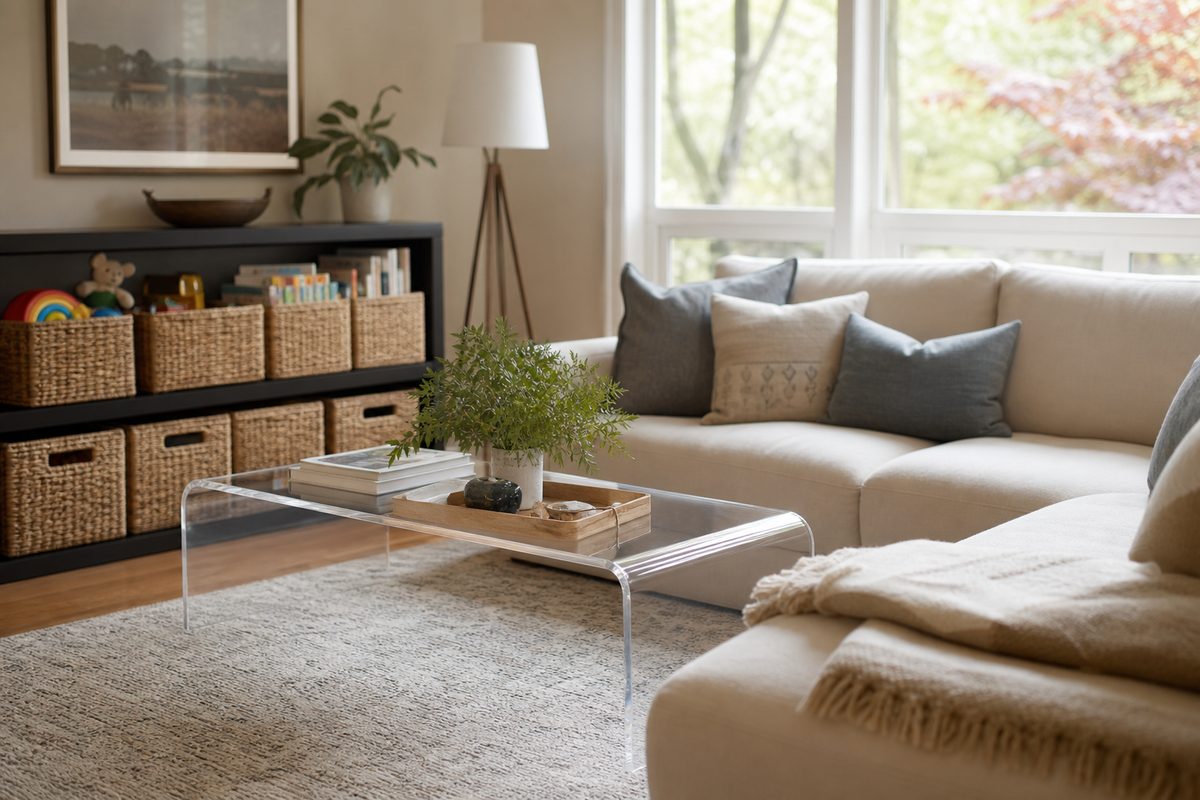
The corollary is that the clutter needs somewhere to go. A basket at the bottom of the stairs for things that belong upstairs, a drawer for the paperwork you have not dealt with, a lidded bin for the toys currently in rotation. Storage is not a substitute for tidying, but it is what makes tidying take seconds.
Let the kids carry real weight
Parents systematically underestimate this, usually because the first few months of a kid doing a chore are slower than doing it yourself. That trade pays back for years.
The American Academy of Pediatrics is direct about it: age-appropriate chores are part of a child’s development, they build life skills and self-esteem, and consistency matters more than perfection. Their guidance also suggests praising effort rather than outcome, which is the part most of us get backwards.
A workable rough progression:
- Preschool: toys into bins, dirty clothes into the hamper, carrying their own plate to the sink.
- Early elementary: making their bed, setting and clearing the table, feeding pets, wiping a low surface.
- Later elementary: vacuuming a room, folding and putting away their own laundry, taking out trash and recycling.
- Middle school and up: a bathroom, a full load of laundry start to finish, and the dishwasher on a rotation.
Two things make it stick. Assign a whole job rather than a piece of one, since “the dishwasher is yours” is easier to own than helping when asked. And accept the quality that comes with the age. A poorly made bed made by a seven-year-old is a win.

Spread the real cleaning across the week
Once the daily reset exists, the actual cleaning gets much smaller, and it fits into the week in pieces rather than a lost Saturday.
The approach that survives contact with a family calendar is one room-sized task per weekday, on the days you know are quieter, plus laundry running continuously in the background rather than as an event.
- Bathrooms get a fast pass midweek: toilet, sink, mirror, a wipe of the floor around the toilet. Keep supplies stored in each bathroom so the task starts instantly.
- Floors get vacuumed in the high-traffic path more often than the whole house. Entry, kitchen, hallway. The bedrooms can wait.
- Kitchen gets its deeper pieces on a rotation: the fridge one week, the microwave and small appliances another.
- Laundry runs on a rhythm rather than a pile, ideally one load started and finished the same day. The load that gets left in the washer is the one that costs you an entire evening later.
If you want the full version of this schedule, our guide to maintaining a clean home between visits breaks it down room by room.
Pets, allergies, and Spokane air
A lot of Spokane households are managing more than mess. Between summer wildfire smoke, high pollen in spring, and pets, indoor air is a real part of family cleaning here.
The EPA’s guidance on asthma triggers in the home lines up closely with what we see work in practice: wash bedding weekly in hot water, vacuum carpets with a HEPA filter, dust with damp cloths rather than dry ones, keep pets out of the bedrooms of anyone with allergies, and hold indoor humidity in a moderate range rather than letting it climb.
Two practical add-ons for family homes here. Damp dusting is not optional if anyone in the house has asthma, because dry dusting relocates rather than removes. And soft surfaces hold the most: bedding, throw blankets, the dog bed, the couch cushions. Those are the things worth washing on a schedule even when they do not look like they need it.
Reduce the amount of stuff, not just the mess
Every system above gets easier when there is less to manage. This is the unglamorous part, and it is the one that changes reset speed the most.
Toy rotation is the highest-return version for households with young kids: keep a portion of the toys accessible and the rest boxed in a closet, then swap every few weeks. Kids play with the available toys more, and the floor holds a fraction of the volume.
The same principle applies everywhere else. A hall closet that is a third empty works. One that is packed generates a pile in the hallway, because nothing can go back in.
When it makes sense to bring in help
There is a point where the math changes. It usually arrives with a second kid, a job with travel, an aging parent to care for, or a season where nobody in the house has a spare hour. What families tell us they are buying is not a clean house. It is the end of the argument about whose turn it was.
The pattern that works best for busy households is dividing the work by type. A crew handles the heavy, time-consuming layer on a schedule: bathrooms, floors, kitchen surfaces, dusting, the detail work nobody gets to. The family handles the daily reset, which is fifteen minutes and stays manageable because the deeper layer never gets away from you.
We have been so impressed by Frontline’s cleaning services from day one. From their communication to customizing each cleaning visit (based on our specific season of life with little kids) all the way down to their attention to detail - their service has been unmatched across the board. We would highly recommend Frontline to anyone!
That is how our recurring maid service is usually set up: a consistent team on a schedule you choose, with the scope built around your house and your season of life rather than a fixed package. For less frequent help, house cleaning covers the same ground on a cadence that fits. If you have not worked with a cleaning company before, what to expect from a first cleaning covers how the first visit runs.
Questions from Spokane parents
How do you keep a clean house with a busy family?
Stop aiming for a house that stays clean and aim for one that resets quickly. That means a drop zone at the door your family actually uses, one clear surface per room, a short daily reset everyone participates in, and the deeper cleaning spread across the week in single-room pieces instead of saved for one long day.
What should you clean every day with kids in the house?
Keep the daily list short enough that it survives a bad day: kitchen counters and sink, the dining table, a floor sweep in the eating area, and everything returned to where it lives. Bathrooms benefit from a thirty-second wipe of the sink and counter. Everything else belongs on a weekly rhythm, not a daily one.
How do I get my kids to actually help?
Assign whole jobs rather than asking for help in the moment, keep the tasks age-appropriate, do the reset together at a fixed time so it is a family activity instead of a punishment, and praise the effort rather than inspecting the result. Expect the quality to lag for a while. Consistency is what makes it stick.
How do you keep a house clean with kids and pets?
Contain what you can at the entry, since paws and boots bring in the same grit. Wash pet bedding, throw blankets, and human bedding on a regular schedule, vacuum the traffic paths more often than the whole house, use a vacuum with a good filter, and dust damp rather than dry. If anyone in the home has allergies or asthma, keeping pets out of that person’s bedroom does more than any single cleaning task.
Is hiring a cleaner worth it when you have young kids?
It depends on what the hours are worth to your household, but the families who find it worthwhile are usually the ones treating it as a division of labor rather than a luxury. The crew takes the heavy recurring layer, the family keeps up the daily reset, and the house stops sliding backward during busy stretches. We scope it in person so the plan matches your home and schedule.
Start with the one that fits this week
You do not need the whole system. Pick the one that matches the mess you are most tired of, and let it run for two weeks before adding another. For most Spokane families, that is the entry drop zone or the nightly fifteen minutes, and either one changes the feel of the house faster than a deep clean does.
If your household has hit the point where the heavy layer needs to leave your calendar, tell us about your home and your schedule. We will send a written estimate within a business day, with a free in-home consultation if you would like one, or call us at (509) 323-7587.