
cleaning tips ·
How to maintain a clean house: a Spokane routine
How to maintain a clean house without losing your weekends: the daily habits, weekly rotation, and seasonal resets that keep a Spokane home steady year round.
By Frontline Housekeeping Plus

Almost everyone who asks us how to maintain a clean house is really asking a different question: why does it never stay that way. They cleaned on Saturday and by Wednesday the counters have grown a layer again, the entry rug has gravel in it, and the bathroom mirror is spotted. It feels like a personal failing. It is not. A house is a system that generates mess continuously, and cleaning it in one heroic weekly push is the least efficient way to fight that. We have cleaned Spokane homes since 2002, and the households whose homes stay genuinely pleasant are almost never the ones working hardest. They are the ones working on a rhythm.
The rhythm has three layers: a handful of daily habits that take minutes, a weekly rotation that spreads the real work across days instead of stacking it on one, and a seasonal reset a couple of times a year. Below is how each layer works, plus the Spokane-specific parts that a generic cleaning schedule will not tell you.

Why the weekend blitz keeps failing
The single-session approach fails for a reason that has nothing to do with discipline. Mess accumulates on a curve, not a line. Crumbs left on a counter become a sticky film. A damp shower left alone grows soap scum, and soap scum in Spokane’s hard water hardens into mineral scale that no longer wipes off. Dust that sits gets walked on, tracked around, and pressed into carpet fibers.
Every one of those things is trivial to remove in the first hour and genuinely difficult a week later. So the weekend blitz is not just longer, it is harder work per square foot, and it delivers a house that looks great Saturday evening and mediocre by Tuesday. The maintenance approach inverts that: you spend less total time and the house is acceptable every single day rather than one day in seven.
The other thing worth naming is that “clean” is not one condition. There is picked-up, which is about clutter. There is clean, which is about surfaces. And there is deep-clean, which is about accumulation in places you do not look. Most people who feel like they are failing are actually doing fine on the second one and drowning in the first.
Layer one: the daily habits
These are small, and their smallness is the point. Together they run about fifteen to twenty minutes and they prevent most of what would otherwise become weekend work.
- Make the bed. It takes two minutes and it changes how the whole room reads, which changes whether you bother keeping the rest of the room in order. This is the cheapest psychological win in the house.
- Clean while you cook, not after. Wipe as you go, wash the prep bowls during the simmer, put things back while the oven does its work. The kitchen ends up mostly clean at the moment the meal is ready, which is when your motivation is highest rather than lowest.
- Wipe the bathroom counter and squeegee the shower. Thirty seconds each. In this area it is the single highest-value daily habit, because our water leaves mineral deposits on glass and fixtures fast. Water that gets wiped off never becomes scale.
- Run one load of laundry. Not a laundry day. One load, start to folded, most days. Laundry only feels overwhelming when it has been allowed to become a pile.
- Do a ten-minute reset before bed. Set a timer, walk the main rooms, and put things where they live. Ten minutes is enough for a whole floor of a normal house, and it means you wake up to a home that is not already behind.
Layer two: the weekly rotation
The weekly layer is the real cleaning: bathrooms, floors, dusting, glass, sheets. The move that makes it sustainable is refusing to do it all in one session. Give each day one job, and no day takes more than twenty or thirty minutes.
A rotation that works for most households looks something like this:
- Monday: dust and glass. Surfaces, sills, mirrors, and the fronts of appliances. Work top to bottom so anything you disturb lands on something you have not cleaned yet.
- Tuesday: bathrooms. Toilets, sinks, tubs, showers. If the daily squeegee is happening, this is a fraction of the job it would otherwise be.
- Wednesday: kitchen deeper pass. Inside the microwave, the front of the refrigerator, the range and its knobs, and the sink drain.
- Thursday: vacuum. Carpets, rugs, and the edges of rooms where the vacuum normally stops short. Do the entry mats first and hardest.
- Friday: floors. Damp-mop hard surfaces. Doing this last means the week’s dust has already been captured rather than pushed around.
- Weekend: sheets and a catch-up slot. Strip and wash bedding, and leave one open block for whatever the week skipped. The catch-up slot is what keeps the rotation from collapsing the first time a day gets away from you.
Which day gets which job matters far less than the fact that each job has a day. If Thursday is always chaos in your house, move vacuuming to Sunday. The rotation is a container, not a commandment.
Layer three: the things Spokane adds
A cleaning routine written for a mild, damp climate will underestimate two things about homes here.
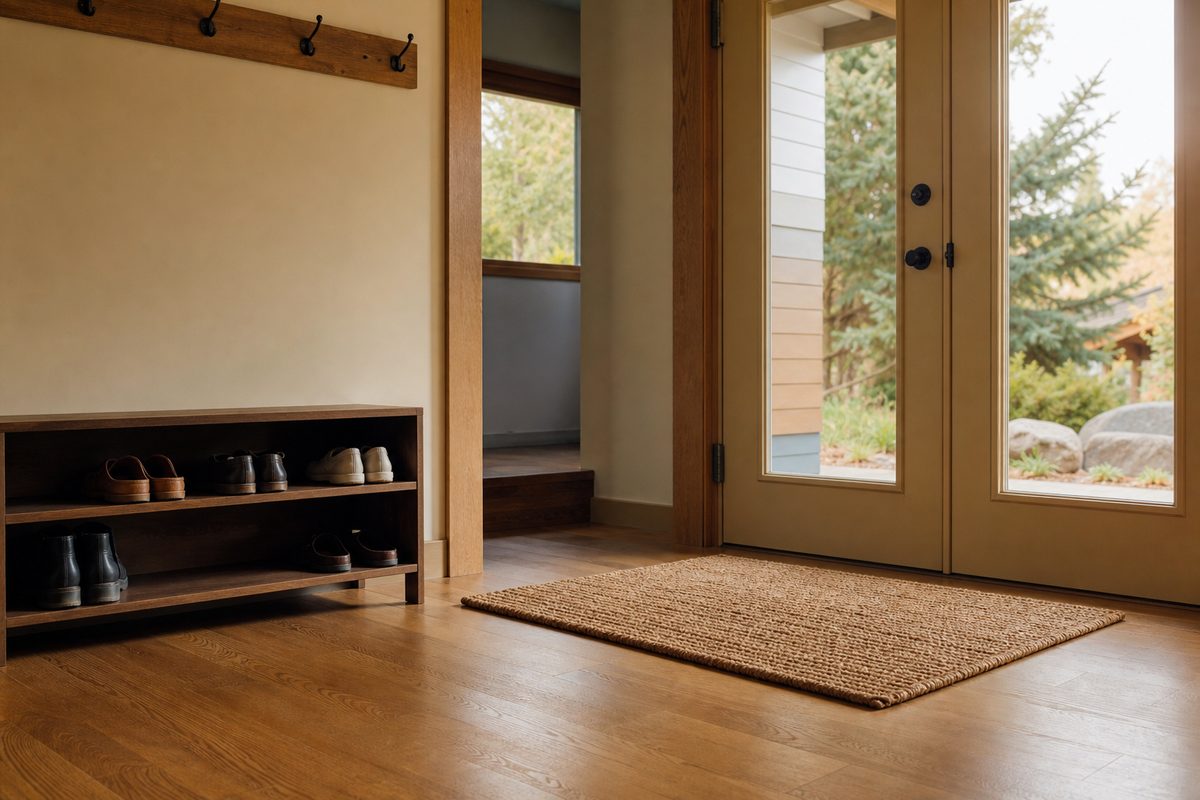
Dust arrives faster than you expect. Our summers are dry and windy, wildfire smoke season is long, and a lot of neighborhoods sit near gravel alleys, construction, or open ground. That combination puts more airborne particulate into a Spokane house than most national cleaning advice assumes. The practical answers are entry control and filtration: real doormats inside and out, shoes off at the door, and a furnace filter changed on schedule rather than whenever you remember. The EPA’s Care for Your Air guide names source control, ventilation, and regular filter changes as the three things that actually move indoor air quality, and all three are maintenance habits rather than one-time projects. If dust is your main frustration, our guide to keeping dust down in a Spokane home goes deeper on the specifics.
Hard water is working against you constantly. Mineral deposits on shower glass, faucets, and around drains are the most common thing we get asked to fix here, and they are almost entirely a maintenance problem rather than a scrubbing problem. Water that is wiped or squeegeed away leaves nothing behind. Water left to evaporate leaves the minerals it was carrying, layer after layer, until it stops responding to ordinary cleaner. That is why the thirty-second squeegee earns its place in the daily list ahead of jobs that feel more important.
The seasons shift the emphasis too. Spring brings pollen. Summer brings dust and smoke. Fall brings leaves and the first mud. Winter brings snowmelt, road salt, and a house that stays closed for months. Our guide to cleaning through Spokane’s four seasons maps what to prioritize when.
The supply setup that makes all of this easier
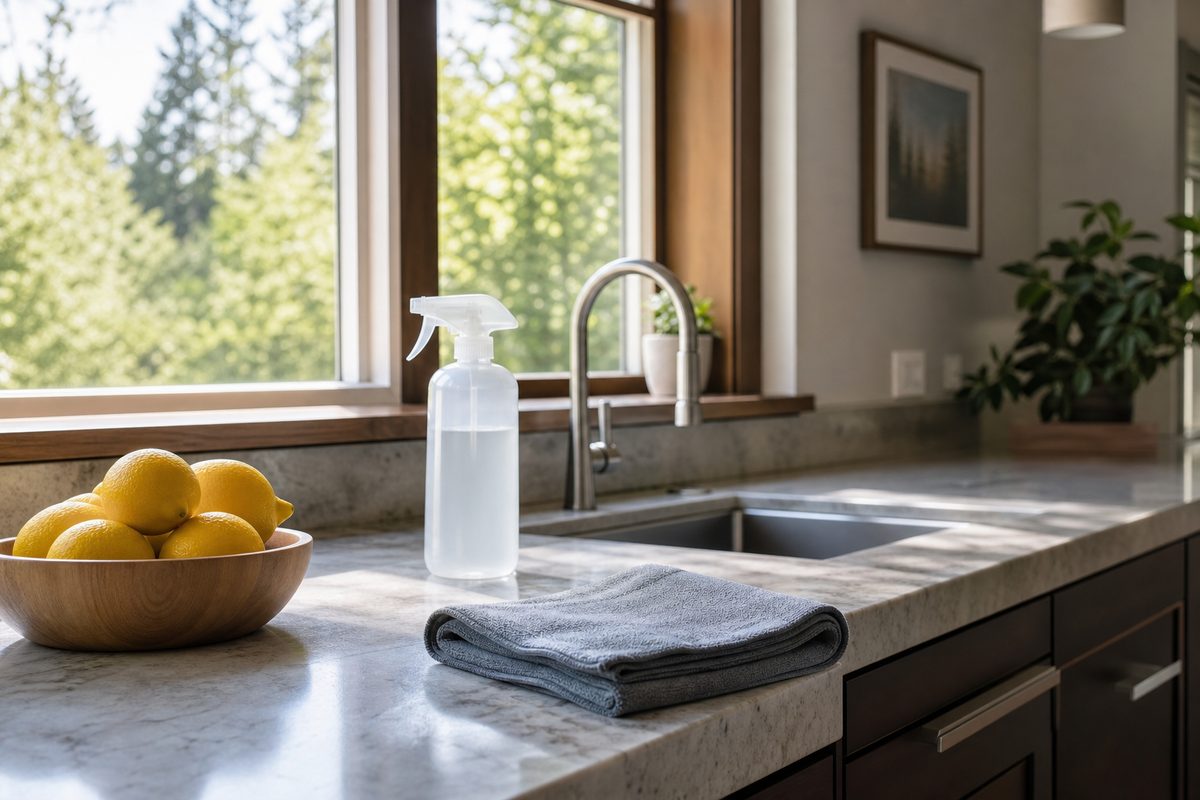
The most common reason a routine dies is friction. If the cleaner for the bathroom lives in a cupboard downstairs, the thirty-second wipe becomes a five-minute errand and stops happening within a fortnight.
Keep a small kit in each bathroom and one in the kitchen: a cloth, an appropriate cleaner, and whatever that room specifically needs. Keep the vacuum on the floor it gets used on. Store the mop where the hard floors are. None of this is about buying more things, it is about removing the seconds of resistance between deciding to do something and being able to do it.
On the products themselves, simpler is usually better. The American Lung Association’s guidance on cleaning supplies and household chemicals points out that many cleaners release volatile organic compounds that can irritate airways, and recommends ventilating while you clean, reading labels, and reaching for plain warm water with soap, baking soda, or a vinegar solution where they will do the job. It also carries the warning worth repeating in every house: never mix bleach with an ammonia-based cleaner. For daily maintenance work, warm soapy water and a microfiber cloth genuinely handle most of it.
When maintenance is not enough
Maintenance holds a line. It does not move one. The places routine cleaning never reaches, meaning the tops of door casings, behind and under furniture, grout, light fixtures, vent covers, window tracks, and mineral scale that has already set, will keep accumulating no matter how consistent your weekly rotation is.
That is what a periodic deep clean is for, and doing one once or twice a year is what keeps the weekly routine from quietly getting longer every month. Spring and fall are the natural moments in Spokane, before and after the house spends a season closed up. Our deep clean checklist walks through it room by room if you want to do it yourself.
Where professional help fits
Plenty of households run this routine themselves and never need us. Others reach a point where the time is worth more than the money, or where the weekly layer is the part that keeps collapsing. There is no virtue in doing it all yourself if the routine has been failing for a year.
What ongoing service actually buys is the weekly layer, reliably, whether or not you had a hard week. You still hold the daily habits, because nobody can make your bed on a Tuesday but you, and those habits are what keeps the house steady between visits. That combination is the version we see work best: the crew handles the rotation, the household handles the ten minutes a day.
The peace of mind, from how they care for my home to the consistency in quality care, Frontline Housekeeping brings each week is truly invaluable. Anna is absolutely stellar, and Kat is fantastic, too. They've even managed to make friends with my anxious pup! I can't imagine the last couple of years without their help each week! Highly recommend.
Questions we get about keeping a house clean
How do I keep my house clean all the time?
Stop trying to clean it all at once. Run a short daily routine of fifteen to twenty minutes, make the bed, clean while you cook, squeegee the shower, run one load of laundry, do a ten-minute reset before bed, and give each of the bigger weekly jobs its own day. The house is never spotless and never far from it, which is what “clean all the time” actually looks like in practice.
How much time a day does it take to keep a house clean?
For a typical home with a working weekly rotation behind it, fifteen to twenty minutes a day of daily habits plus twenty to thirty minutes on that day’s rotation job. That is under an hour most days and considerably less total time than a single weekend session, because nothing has been left long enough to become difficult.
What should I clean every day, every week, and every month?
Daily: dishes, counters, the bathroom sink and shower, one load of laundry, and a quick pick-up. Weekly: bathrooms, floors, dusting, glass, and sheets, spread across days. Monthly: the refrigerator interior, the range hood, baseboards, light fixtures, and window sills and tracks. Once or twice a year: a full reset that covers grout, behind furniture, vents, and mineral scale.
What is the best cleaning schedule for a busy household?
One job per day, always on the same day, with a catch-up block on the weekend. Fixed days remove the daily decision about what to do, which is the part busy households actually run out of. Keep supplies in the room where they get used so no job requires a trip, and let the weekend block absorb whatever the week dropped rather than treating a missed day as a broken system.
How often should you deep clean if you clean regularly?
Once or twice a year for most homes on a consistent routine, usually spring and fall. A steady weekly rotation prevents most buildup, but it cannot reach grout, behind appliances, window tracks, light fixtures, or set mineral scale. If those places are starting to show, that is your signal regardless of what the calendar says.
Start with one layer
If you take one thing from all of this, make it the ten-minute reset before bed. It is the smallest habit here and the one that changes the most, because it means every day starts from level rather than from behind. Add the weekly rotation once that feels automatic. Worry about the seasonal reset after that.
If the weekly layer is the part that never happens in your house, that is exactly the piece we handle. Our house cleaning and maid service pages cover what a recurring rotation includes and how often it can run.
Anywhere in Spokane and the surrounding area, tell us about your home and we will send a written estimate within a business day, with a free in-home consultation if you would like one.