
cleaning tips ·
Airbnb turnover cleaning checklist for Spokane hosts
An Airbnb turnover cleaning checklist built for real Spokane turnarounds: the room-by-room order, the details guests photograph, and what to reset every stay.
By Frontline Housekeeping Plus

A good Airbnb turnover cleaning checklist is not really a cleaning document. It is a timing document. Checkout is at eleven, check-in is at four, and somewhere in that window a property has to go from lived-in to photograph-ready without anyone rushing so hard that they skip the underside of the toilet seat. We have cleaned Spokane properties since 2002, including short-term rentals turning over on the busiest event weekends of the year, and the hosts who never get a cleanliness complaint are almost never the ones cleaning hardest. They are the ones cleaning in the same order every single time.
That is the whole idea behind this checklist. A fixed sequence removes decisions, and removing decisions is what makes a turnover fast. Airbnb itself asks hosts to follow a consistent five-step cleaning process between stays for the same reason: repeatability beats effort. What follows is the Spokane version, room by room, with the local details that trip up hosts here in particular.

Before you clean anything: the walk and the laundry
The first five minutes of a turn set the clock for the rest of it.
Walk the unit with your phone out. Look for damage, stains, missing items, and anything that needs reporting before the next guest arrives and inherits it. This is also when you find the things that change your plan: a red wine spill on a light rug, a pet that was not disclosed, a burner left crusted.
Strip every bed and start the first load immediately. Laundry is the only task in a turnover that runs on its own clock, and the dryer is what makes a same-day turn late. Start it before you touch a single surface.
Open windows if the air outside allows it. Spokane summers complicate this. During smoke season, keep the unit closed and let the HVAC do the work instead. Airing out a unit while the valley is hazy just moves the problem indoors.
Take out all trash and recycling, including bathroom and bedroom bins. Nothing else gets clean while old trash is still in the unit.
Kitchen
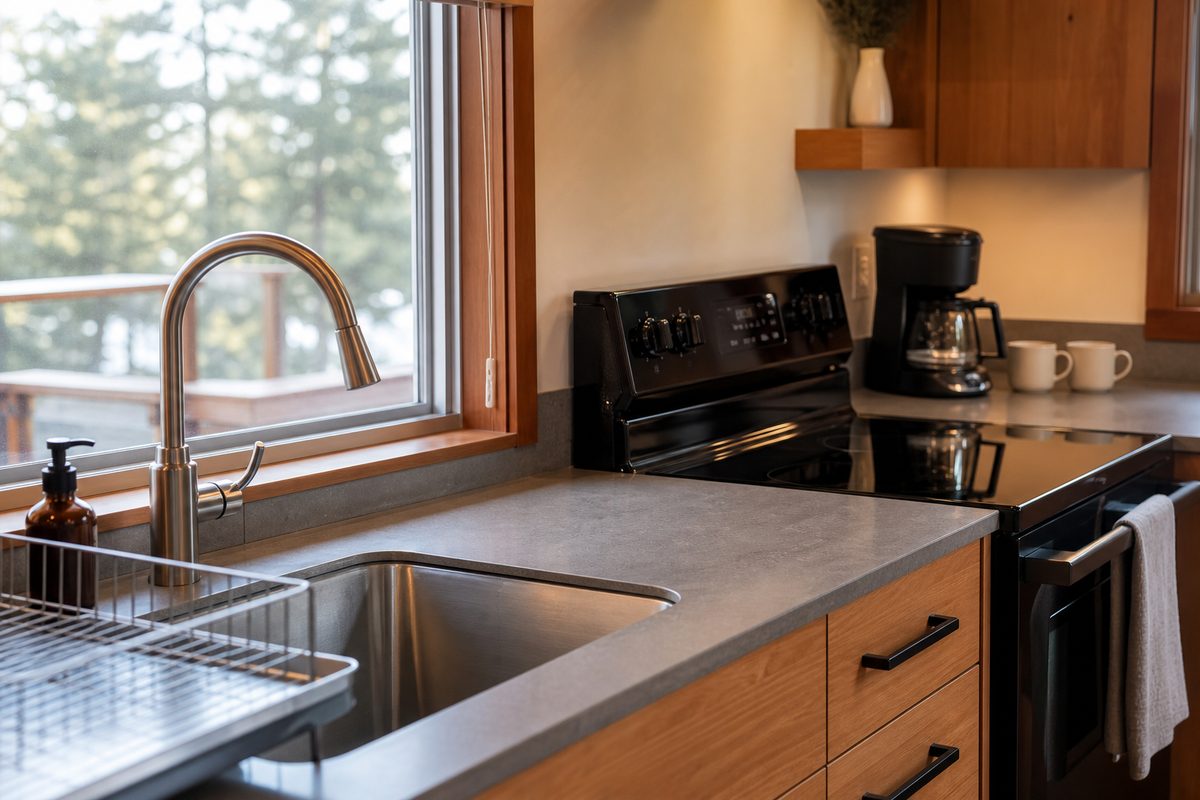
The kitchen is where a turnover most often gets caught, because the previous guest cooked and the next guest inspects.
- Run and empty the dishwasher first, so it is available and empty at check-in.
- Wash, dry, and return anything left in the sink or the drying rack. Nothing goes back in a cupboard damp.
- Wipe the inside of the microwave, including the ceiling of it, which everyone forgets.
- Check the refrigerator and freezer: remove all guest food, wipe shelves and the door bins, and look for spills that have run down the back wall.
- Wipe cabinet fronts, especially around the handles where hands land.
- Clean the stovetop, the drip areas, the oven door glass, and the range hood face.
- Wipe small appliances and reset the coffee station. Empty the coffee maker, rinse the carafe, restock filters and pods.
- Wipe the counters last, then the sink and faucet. Dry the faucet so it shines rather than spots.
- Sweep and mop the floor, including under the edge of the cabinet toe kick where crumbs collect.
- Restock: dish soap, sponge, dishwasher pods, paper towels, trash bags, and any welcome items you promise in the listing.
Bathrooms
Bathrooms are the room guests inspect most closely and the room most likely to generate a review comment. Slow down here.
- Toilet: bowl, seat top and underside, hinges, base, and the wall or floor immediately behind it.
- Shower and tub: walls, floor, drain, and any door track. Check the grout lines and the caulk seam.
- Glass and chrome: this is where Spokane water shows. Mineral scale films the glass and dulls fixtures, and it does not respond to more scrubbing, it responds to an acidic descaler. Our guide to removing hard water stains covers the method we use, and it belongs in every turnover kit here.
- Mirror: clean it, then check it again from an angle with the light on. Streaks are invisible head-on and obvious to a guest doing their hair.
- Vanity, sink, and faucet, then dry everything.
- Floor last, including behind the toilet and along the baseboard.
- Restock: toilet paper with a spare in plain view, hand soap, and fresh towels folded the same way every time.
- Empty the bin and replace the liner.

Bedrooms
- Make every bed tightly, with clean linens and no wrinkles. A loose, lumpy bed undoes an otherwise perfect unit in the guest’s first photo.
- Check under the bed and between the mattress and the headboard. Chargers, socks, and small items live there, and a guest who finds a stranger’s belongings assumes nothing was cleaned.
- Inspect pillows and mattress protectors for stains. Protectors are washed, not wiped.
- Wipe nightstands, lamp bases, switches, and the headboard itself.
- Empty and wipe out closets and drawers, and reset the hangers to an even count.
- Dust flat surfaces and any window sills, then vacuum, including along the baseboards and under furniture edges.
Living areas and the whole-unit pass
- Reset the furniture to its listing-photo positions. Guests move things, and the unit should look like what they booked.
- Fluff and straighten cushions and throw pillows, and check under and behind the couch cushions.
- Wipe the coffee table, side tables, and any glass, including television screens.
- Wipe the high-touch list: light switches, door handles, remotes, thermostat, and railings. Cleaning comes first and disinfecting second, since dirt on a surface keeps a disinfectant from reaching what is under it.
- Dust visible surfaces top down: shelves, frames, fan blades, and the tops of doors.
- Vacuum and mop all floors, working toward the exit door so you are not walking back across finished floor.
- Check every light bulb, the smoke and carbon monoxide alarms, and the batteries in the remotes.
- Reset the thermostat to your standard arrival setting.
The final pass, and why you photograph it
Walk the unit one more time from the front door, the way a guest will. Look at eye level, then look low. Get the lights on the way you want them at check-in. Then take the same set of photos every turn: each bed, each bathroom, the kitchen counter, and the living room.
Those photos take two minutes and do three jobs. They prove the condition of the unit at handoff if a guest reports something. They catch the crooked pillow or the smudge you stopped seeing an hour ago. And over a season, they show you which details your process keeps missing, which is how a checklist actually improves.
What a turnover does not cover
A turnover is a reset, not a deep clean, and confusing the two is how a rental slowly declines while every individual turn looks fine. Buildup happens on a slower cycle than guests do.
On a regular schedule, plan for the things no turnover has time for: inside the oven and under the range, the refrigerator coils, the range hood filter, baseboards and door frames throughout, window tracks and interior glass, light fixtures and fan blades, upholstery and mattresses, grout, and the interior of every closet and cabinet. Our deep cleaning checklist lays out the full scope room by room.
For most Spokane rentals, a full deep cleaning between seasons works well: once heading into the summer travel run, and again after it, when the smoke season film and the first tracked-in weather have both had their turn.
Regulations are part of being turnover-ready
Cleaning is not the only thing a host has to keep current here. The City of Spokane permits short-term rentals as their own use, with an application per rentable unit, annual renewal, and a notarized annual life safety compliance form covering things like alarms and escape routes. The safety items on that form overlap directly with your turnover checks: working smoke and carbon monoxide alarms, clear exits, and posted information. Building them into the turn means you are never scrambling at renewal.
When it makes sense to hand off the turn
Plenty of Spokane hosts clean their own units, and if you live nearby with a flexible calendar, that works. It stops working at the point where you have back-to-back bookings, a second property, a day job, or a guest whose flight lands at two in the afternoon.
That is the point where the value of a crew is not the cleaning, it is the reliability. Same team, same sequence, same standard, on a date you did not have to negotiate.
We find Frontline service to be incredibly reliable and top notch. Bailey and Sammy are fantastic. They are incredibly flexible and they're so sweet to our pets 🐾 …
Our Airbnb turnover cleaning is built around host timing: we work to your checkout and check-in windows, follow your unit’s own checklist, and flag damage or missing items so you hear it from us before you hear it from a guest. If you have never worked with a cleaning company before, what to expect from a first cleaning walks through how the first visit runs.
Host questions we hear most
What should be included in an Airbnb turnover clean?
A full reset of every room: fresh linens and towels, all bathrooms cleaned and restocked, the kitchen washed down with the dishwasher emptied and the refrigerator cleared, all floors vacuumed and mopped, high-touch surfaces wiped, trash removed, supplies restocked, and the furniture returned to its listing-photo positions. A damage and inventory check belongs in it too, since the turn is the only time anyone is looking at the unit with fresh eyes.
How long does an Airbnb turnover cleaning take?
It depends on the size of the unit, how many beds and baths there are, and how the last guest left it. A studio or one-bedroom that was treated well is a short visit. A multi-bedroom home after a large group, or a unit with pets, takes considerably longer. Laundry capacity usually sets the real floor, which is why extra linen sets matter so much.
What is the difference between a turnover clean and a deep clean?
A turnover restores the unit to its standard between guests and runs on a tight clock. A deep clean addresses what accumulates underneath that cycle: oven interiors, grout, baseboards, window tracks, upholstery, appliance interiors, and light fixtures. Turnovers keep the listing consistent day to day, and deep cleans keep the property from drifting downward over a season.
How often should a short-term rental be deep cleaned?
A reasonable rhythm for Spokane properties is twice a year, anchored to the seasons that do the most damage: once before the summer travel peak and once after it, when wildfire smoke residue and outdoor dust have settled in. High-traffic units, pet-friendly listings, and larger homes usually benefit from a quarterly cadence instead.
Who is responsible for cleaning between guests?
The host is, whether they do it themselves or hire it out. Guests are typically expected to leave the unit in reasonable condition and follow whatever checkout steps are posted, but the actual turnover is the host’s obligation, and cleanliness ratings land on the host’s listing.
Make the next turn the easy one
The best thing about a turnover checklist is that it stops being a checklist. After enough repetitions, the order lives in your hands, and the whole turn gets quieter and faster without getting thinner.
If you host anywhere in Spokane or the surrounding area and you would rather hand the turns to a crew that runs the same sequence every time, tell us about your property. We will send a written estimate within a business day, with a free walkthrough if you would like one. You can also reach us at (509) 323-7587.