
seasonal ·
How to clean and organize a mudroom for a Spokane winter
How to clean and organize a mudroom and garage before a Spokane winter: gear storage, boot trays, salt containment, floor protection, and the last dry sweep.
By Frontline Housekeeping Plus

If you want to know how to clean and organize a mudroom so it actually survives a Spokane winter, start by thinking of it as a valve rather than a room. Everything the season throws at a house, snowmelt, road sand, deicer, wet dog, five months of boots, has to pass through that one space on its way to the rest of the house. Whether you have a proper mudroom, a garage entry, or a back hall with a bench and three hooks, the transition zone decides how much of winter reaches your floors. We have cleaned Spokane homes since 2002, and by February the difference between a household that set this space up in September and one that did not is visible from the front door. Here is the reset we recommend, and why the timing matters.
Why September is the month for this
Most organizing advice is timeless. This job is not, because two Spokane facts set the deadline.
First, the garage. Through September it is still warm and dry enough to pull everything out onto the driveway, hose the floor, and let it dry in an afternoon. By late October the mornings are freezing, the floor will not dry, and once the first snow falls the door stays shut, the slush starts arriving, and whatever state the garage was in is the state it stays in until April.
Second, the mudroom has to be rebuilt before winter, not during it. The moment the first wet boots come through the door the space is in use every day, and it is very hard to reorganize a room that is never empty. Do it while the hooks are holding light jackets, so the system is ready on the first snowy morning rather than improvised on it.
The city’s own snow removal program treats arterial streets and bridges with liquid deicers along with salt and sand mixtures, and all three of those come home on boots and tires. The mudroom is where you decide whether they stop at the door or spread across the house.
Step one: empty it completely
Everything comes out. Not “tidied around,” out. Coats off the hooks, shoes out of the cubbies, the bench emptied, the bins pulled, the mats rolled up and carried outside. Do the same in the garage entry if that is where the family actually comes in, because in most Spokane houses the garage door is the real front door.
Sort as you go into four piles: winter gear that stays, summer gear that moves to storage, things that belong elsewhere in the house (the mudroom collects mail, dog leashes, garden gloves, and a surprising number of single mittens), and things that leave for good. A mudroom only works when it holds what the season needs and nothing else, and the boots that did not fit last year will not fit this year either.
Once it is empty you will see the room for the first time since spring: the scuffed baseboard behind the bench, the grit in the corners, the salt ring where the tray used to sit. That is what you are cleaning next.
Step two: clean it once, properly
An empty mudroom cleans in under an hour, and it is the only hour it will get all winter, so make it count. Work top to bottom.
- High surfaces first. Wipe the top of the cubbies, the shelf above the hooks, and the light fixture. Dust the vent cover if there is one, since this room often shares a wall with the garage and pulls in more dust than the rest of the house.
- Walls, hooks, and baseboards. Scuff marks, fingerprints around the light switch, and the gray band along the wall at coat height all come off with warm water and a little dish soap on a microfiber cloth. Wipe each hook and the hardware on the bench. Baseboards in this room take a real beating from boots and bags; a damp cloth along the top edge and face lifts a season of grit.
- Inside the cubbies and bins. Vacuum out the sand and dried mud, then damp-wipe. Plastic bins go outside for a rinse.
- The floor, last. Vacuum every corner and along the baseboards, then damp-mop with a neutral cleaner. If there are white salt marks from last winter, they need a slightly wetter pass and a second rinse; a barely damp mop just pushes salt around.
- The mats, outside. Shake, then hose the rubber-backed mats and the boot tray, scrub with a stiff brush, and let them dry fully in the sun before they come back in.
If the room has a floor drain or tile that can take it, this is the one time of year to scrub the grout lines, which hold last winter’s sand like nothing else.
Step three: build the containment system
Now rebuild the room, from the door inward, around one idea: stop the mess as close to the door as possible.
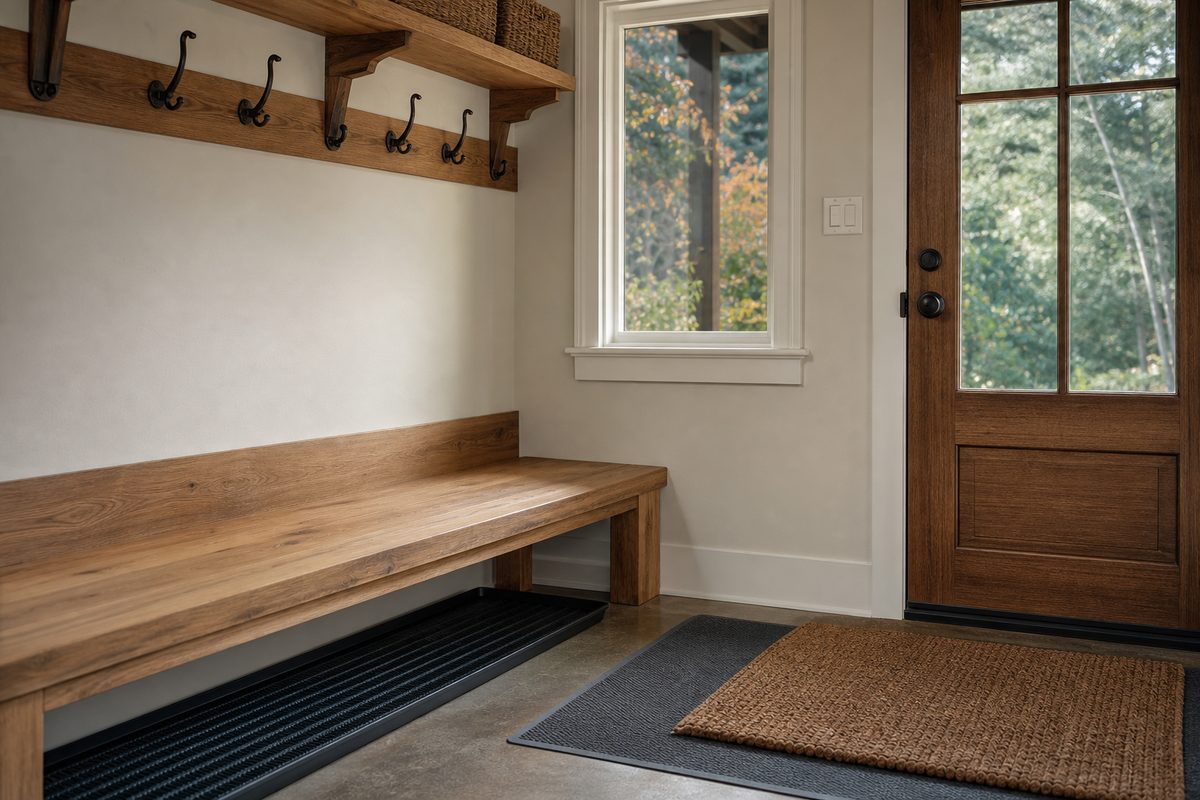
Mat one, outside. A coarse, scraper-style mat on the step or in the garage bay, big enough for a full stride. This is where the sand and the worst of the slush come off.
Mat two, inside. An absorbent, rubber-backed mat immediately inside the door, wider than the doorway, to catch the snowmelt the first mat missed. Between the two mats, the majority of what a Spokane winter tracks in never makes it another step.
The boot tray. A ribbed or lipped tray, sitting on or beside the inside mat, where wet boots live until they are dry. The ribs lift boots out of their own puddle, and the lip keeps the puddle off the floor. Size it for the whole household plus a guest pair; a tray that is always full is a tray that gets skipped.
The bench. Whatever you have, from a built-in with cubbies to a sturdy stool, put it beside the tray so boots come off sitting down. The bench is the single thing that makes shoes-off actually happen, because standing on one foot in a wet doorway does not.
Hooks, at two heights. Adult height for coats and a lower row that children can reach on their own. Hooks beat closets in a mudroom because a wet coat on a hook dries; a wet coat in a closet does not.
A wet bin and a dry bin. One open basket for damp hats, gloves, and scarves to dry in, and labeled bins or a cubby per person for the dry spares. The wet bin is the piece most families skip and the reason gloves end up scattered on the radiator.
A towel on a hook by the door. For the dog, for the floor, for the snow that came in on a hood. It will be the most used item in the room.

Step four: protect the floor before the first snow
Every winter we see the same damage in the same spot: the three feet of floor just inside the door, where boots come off. Snowmelt sits, salt dries to a chalky ring, and sand grinds into the finish underfoot. On hardwood it dulls the finish; on tile it settles into the grout; on carpet it is a permanent traffic lane by January.
The fix is to decide, in September, what covers that spot: a large rubber-backed runner that can be lifted and hosed, a boot tray wide enough that boots never touch bare floor, and on hardwood a mat with a waterproof backing rather than a jute or natural fiber mat that soaks through. If the drop zone is in the garage, a heavy mat where you step out of the car does the same job.
The full method for the stains themselves, and why salt marks in particular need a specific approach, is in our guide to winter mud, snow, and salt on Spokane floors. Everything in this post is about making sure you need that guide as little as possible.
Step five: the garage, before the first freeze
The garage is the outer layer of the same system, and it gets its own short checklist. Do this on a warm, dry weekend, because it is a driveway job.
- Pull it out. Bikes, camping gear, patio cushions, the lawn chairs. Anything summer goes to the back or up on the wall; anything winter, the snow shovels, the ice scraper, the bag of sidewalk salt or sand, the sled, moves to the front by the door where you can reach it in the dark at seven in the morning.
- Sweep and hose. A push broom over the whole floor, then a hose, then let it dry with the door open. This is the last time the floor will be clean and dry until spring, and a clean garage floor in October means far less grit in the mudroom in December.
- Clear the path. Make sure there is an uncluttered route from the car door to the house door. In January that path is where the snow, salt, and slush concentrate, and every box or bike stored along it becomes a thing you drip on.
- Stage the winter kit. Shovels on hooks by the door, salt or sand in a lidded bucket with a scoop, a stiff broom for the steps, and a second boot tray or mat at the garage-to-house threshold if that is the real entry. The city asks property owners to keep sidewalks clear through the snow season, so the shovel should be the first thing you can grab, not the last.
- Check the door seals. The weatherstrip along the bottom of the garage door and the sweep on the house door are what keep drifting snow and cold out of the garage. A cracked seal in September is an easy fix; the same seal in December is a puddle.

Keeping it working through the winter
A mudroom is cleaned in September and maintained every week after that. The maintenance is small if the setup is right.
- Daily, ten seconds: wet things onto the tray or into the wet bin, coats onto hooks, towel back on its hook.
- Weekly, ten minutes: shake the mats outside, empty and rinse the boot tray, vacuum the floor and corners, and damp-mop the drop zone so salt never dries into a ring. On our regular house cleaning visits in winter, the entry gets this treatment every time, because it is the room that reloads fastest.
- After every storm: wipe the salt marks while they are still damp, when they come off with plain water. Once they dry white, they take more work.
- Monthly: pull the bins, vacuum behind and under the bench, and wipe the hooks and baseboards. This is also when the wet bin gets emptied of the mittens nobody claimed.
Families with school-age kids will recognize the drop-zone habits from our back-to-school cleaning checklist; the winter version is the same routine with a tray and a towel added.
We have been using Frontline Housekeeping for about a year. They are friendly, courteous and thorough. If you need special attention to a certain area of your home, then simply ask them and it will taken care of. I highly recommend using them.
Questions we hear every fall
What should be in a mudroom for winter?
An outside scraper mat and an inside absorbent mat, a ribbed boot tray, a bench to sit on while boots come off, hooks at adult and child height, an open basket for wet hats and gloves, a labeled bin or cubby per person for dry spares, and a towel on a hook by the door. Summer gear should be stored elsewhere so the room only holds what the season needs.
How do I keep my mudroom from getting messy?
Give every category one obvious home and make the path from the door to that home shorter than the path to the floor. A bench beside the tray makes shoes-off automatic, hooks make coats dry instead of piling, and a wet bin stops gloves from scattering. Then hold a weekly ten-minute reset so nothing accumulates.
Where should you store winter gear if you do not have a mudroom?
Build the same system at whichever door the family actually uses, usually the garage entry. A mat outside, a mat inside, a boot tray, a stool or small bench, and a row of hooks fit in a hallway or a laundry room. What matters is a place for wet things to stop, not a dedicated room.
How do you clean a mudroom floor after snow and salt?
Vacuum the sand first, then damp-mop with a neutral floor cleaner. Salt marks come off easiest while still damp; once they dry to a white ring they need a slightly wetter pass and a clean-water rinse. Avoid soaking hardwood, and shake or hose the mats outside rather than vacuuming grit deeper into them.
When the reset is bigger than a Saturday
Some mudrooms have not been emptied in years, and the honest first step is a real cleanout rather than a tidy: cubbies emptied, walls and baseboards washed, grout scrubbed, and the floor cleaned to bare before the system goes in. That is the kind of one-time reset our deep cleaning is built for, and it pairs naturally with a fall deep cleaning before winter for the rest of the house.
If you are anywhere in Spokane or the surrounding area and want the transition zone handled before the first snow, tell us about your home and we will send a written estimate within a business day, with a free in-home consultation if you would like one.