
cleaning tips ·
Safe cleaning products for your home: a Spokane guide
How to choose safe cleaning products for your home without losing cleaning power, what the labels really mean, and what works on Spokane hard water.
By Frontline Housekeeping Plus

Choosing safe cleaning products for your home sounds like it should be simple: read the front of the bottle, pick the one with a leaf on it, done. In practice it is one of the most confusing aisles in the store, because the words that reassure you most are the ones nobody has to earn. “Natural,” “green,” “eco,” “non-toxic,” and “plant-based” are marketing terms, not regulated claims. A bottle can carry all five and still be the harshest thing under your sink. We have cleaned Spokane homes since 2002, in houses with toddlers, cats, and hundred-year-old fir floors, and the way we choose a product has almost nothing to do with the front label.
Here is how we actually decide: what to read instead of the marketing, which ingredients deserve caution, what to keep for the jobs where nothing gentler works, and the Spokane wrinkle that trips up half the people who switch and then give up.
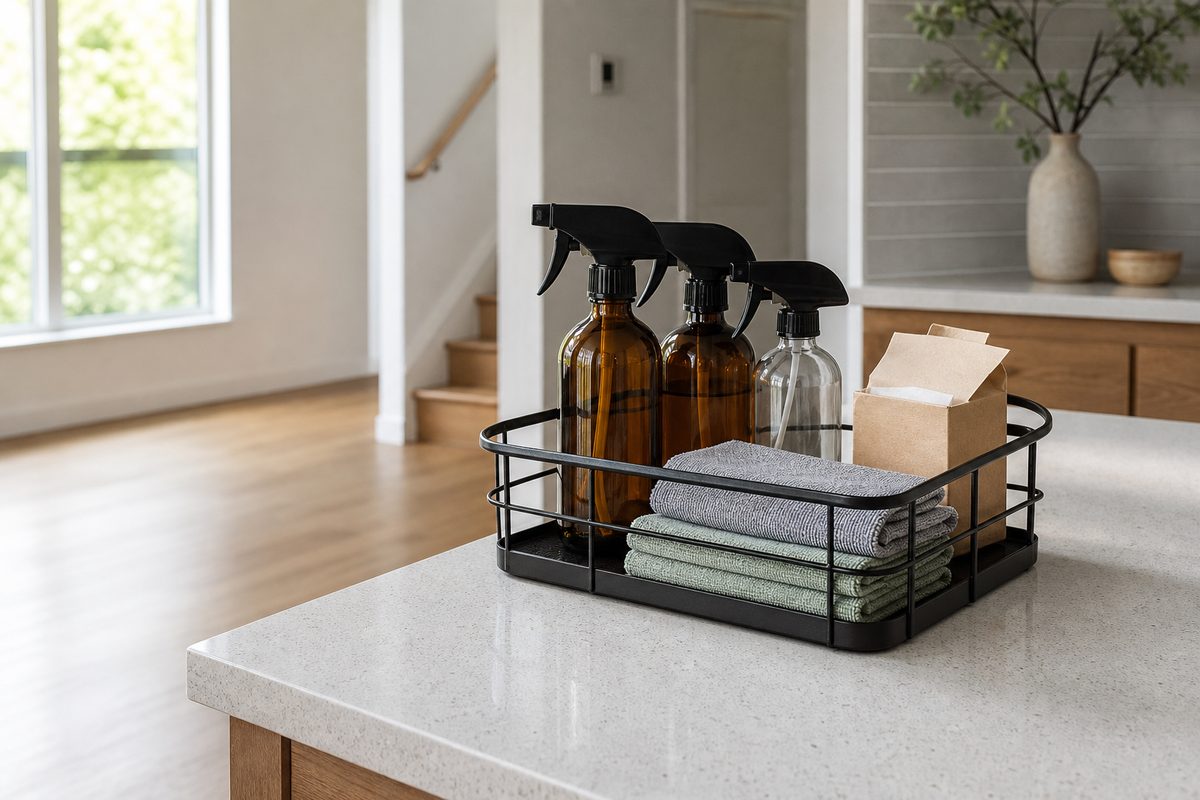
The front of the bottle is advertising. The back is information.
There is no legal definition a company has to meet before printing “natural” or “non-toxic” on a label. The American Lung Association makes this point directly in its guidance on cleaning supplies and household chemicals: labels like green or natural do not guarantee a product is safe, and it is worth researching one before you buy rather than trusting the packaging.
So we ignore the front and look at three things on the back:
- The signal word. Hazard signal words follow a consistent ladder: CAUTION is the mildest, WARNING is a step up, and DANGER or POISON is the top of the scale. A product with no signal word at all is generally the mildest thing on the shelf. That one word tells you more in a second than the entire front panel does.
- The ingredient list. Not every cleaner has to publish a full one, and that itself is informative. A company that prints every ingredient has decided it can defend every ingredient. A list that ends at “fragrance” is asking you to take the rest on faith.
- The directions. “Ventilate the area,” “wear gloves,” and “rinse thoroughly” are the manufacturer telling you how much respect the product wants. People skim past this and then wonder why a bathroom gave them a headache.
The one label that actually means something
If you want a single shortcut, it is the EPA’s Safer Choice mark, the only common label on an American cleaning product that reflects a government ingredient review rather than a marketing department.
To carry the mark, every ingredient is reviewed by EPA scientists against criteria for carcinogenicity, reproductive and developmental toxicity, aquatic toxicity, and environmental persistence. The product also has to hit pH limits that reduce skin and eye irritation, stay under a cap on volatile organic compounds, and perform comparably to a conventional product in its category. That last part is why the label is worth looking for: it screens out the gentle products that do not clean.
Dyes and fragrance ingredients get screened too, and there is an optional fragrance-free version of the mark. Around two thousand products qualify, stocked at ordinary grocery and hardware stores.
The short list of ingredients worth avoiding
You do not need to memorize a chemistry syllabus. In real homes, a handful of categories account for nearly all of the trouble.
- Ammonia. A strong respiratory and eye irritant, and the most common ingredient in glass cleaners. It is also half of the most dangerous mixing accident in home cleaning.
- Chlorine bleach. It works, and there are jobs where nothing else does, but the fumes irritate airways and it reacts badly with things people keep nearby. A specialist tool, not a daily wipe-down.
- Anything sold as an air freshener. The lung association recommends avoiding these, and notes that even natural fragrances such as citrus can react indoors to produce other pollutants. A house that smells like nothing is the goal.
- Aerosol sprays. The delivery method matters as much as the contents. An aerosol puts a fine mist of product into the air you are standing in; a trigger sprayer aimed at a cloth does not.
- Vague “fragrance.” Not because scent is sinister, but because it is where the ingredient list legally stops. If a household has someone with asthma, and after two decades of Spokane smoke seasons a lot of them do, fragrance-free is the easy default.
The mixing rules nobody should break
This is the part where “natural” causes actual harm, because people assume a gentle ingredient cannot participate in a dangerous reaction. It can.
Never mix bleach with ammonia. The lung association’s guidance could not be clearer: never combine bleach or a bleach-containing product with a cleaner containing ammonia. The result is chloramine gas, which can cause serious breathing problems. The trap is that you do not have to be mixing anything on purpose. Bleach in a toilet and an ammonia glass cleaner on the mirror above it, in a small closed bathroom, is the same mixture with extra steps.
Never mix bleach with vinegar or any acid. Vinegar is about as homey as an ingredient gets, which is why this one catches people. Add an acid to bleach and it releases chlorine gas.
Do not stack products hoping for a stronger result. Cleaners are formulated to work alone, and two in one bucket do not add up. If a surface needs a second product, rinse the first one off and let it dry.
What actually cleans a house
Once you strip out the specialty products, most of a house comes clean with a very short list.
- Warm water and dish soap handles most hard surfaces: counters, cabinet faces, trim, doors, appliance exteriors, painted walls. Not a compromise version of cleaning, but what we reach for first.
- Baking soda is a mild abrasive for sinks, tubs, and cooktop grime that needs friction rather than chemistry.
- Diluted vinegar handles glass and, more to the point in this town, mineral scale.
- Microfiber, and enough of it. A quality cloth lifts and holds soil mechanically, so the product has less work to do. Most people fail with gentle products because they use one increasingly dirty cloth for a whole floor of the house. We go through a stack per home for this reason.
- A HEPA-filter vacuum, because much of what makes a house feel dirty is particulate you should be removing rather than wiping around.
Notice how little of that is a product. Method, agitation, and clean cloths do more of the work than the bottle does.
The Spokane wrinkle: hard water
Now the local part, and the reason a lot of Spokane households try gentler products and quietly go back to the harsh stuff. Our water is hard. Every time it dries it leaves dissolved minerals behind, which is why shower glass hazes over, faucets grow a crust at the base, and a freshly wiped window dries into spots. That chalky film is a mineral deposit, and mineral deposits do not respond to soap or to scrubbing pressure. They respond to acid.
So people switch to a gentle all-purpose cleaner, watch it fail on shower glass, and conclude that safer products do not work. The product is not the problem, it is the wrong category of product for that soil. Scale needs an acid, whether diluted white vinegar or a citric-acid descaler, plus dwell time. Spray it, walk away, come back, then wipe. Pressure is not what removes it, patience is. The full method is in our guide to removing hard water stains in Spokane homes.
Two cautions that matter more here than almost anywhere:
- Keep acid off natural stone. Vinegar and other acids etch marble, granite, limestone, travertine, and slate, and etching is permanent. Stone gets a pH-neutral cleaner, full stop.
- Keep baking soda off glass, glossy cooktops, and finished wood. It is abrasive, and on the wrong surface it leaves fine scratches or a dulled finish that no amount of polishing brings back. In the older Spokane houses we clean, the abrasive shortcut is the most common source of damage we get called in after.
Households with kids and pets
The reason to care about all of this is usually crawling around on the floor. Small children and pets live at ground level, put their hands and paws in their mouths, and breathe a larger volume of air relative to their size than adults do. They meet whatever you left on the floor before anyone else does. A few practical adjustments:
- Rinse floors, or use a product designed to be left without rinsing. A residue that stays on the surface is one somebody will end up touching.
- Go fragrance-free in the rooms where the smallest members of the household spend the most time.
- Be careful with essential oils around pets. Plant-derived is not a synonym for animal-safe, and the FAQ below covers why.
- Store everything up high and closed, including the gentle products.
If your household includes shedding animals, the products are only half the equation anyway. Removal beats dilution every time, which is the whole argument in our guide to cleaning up pet hair and dander.
Frontline is not only professional by very friendly, they use products that not only clean your home but are good for the environment. They clean things I didn’t know needed clean! I would highly recommend them to anyone wanting the clean home dreams are made of!
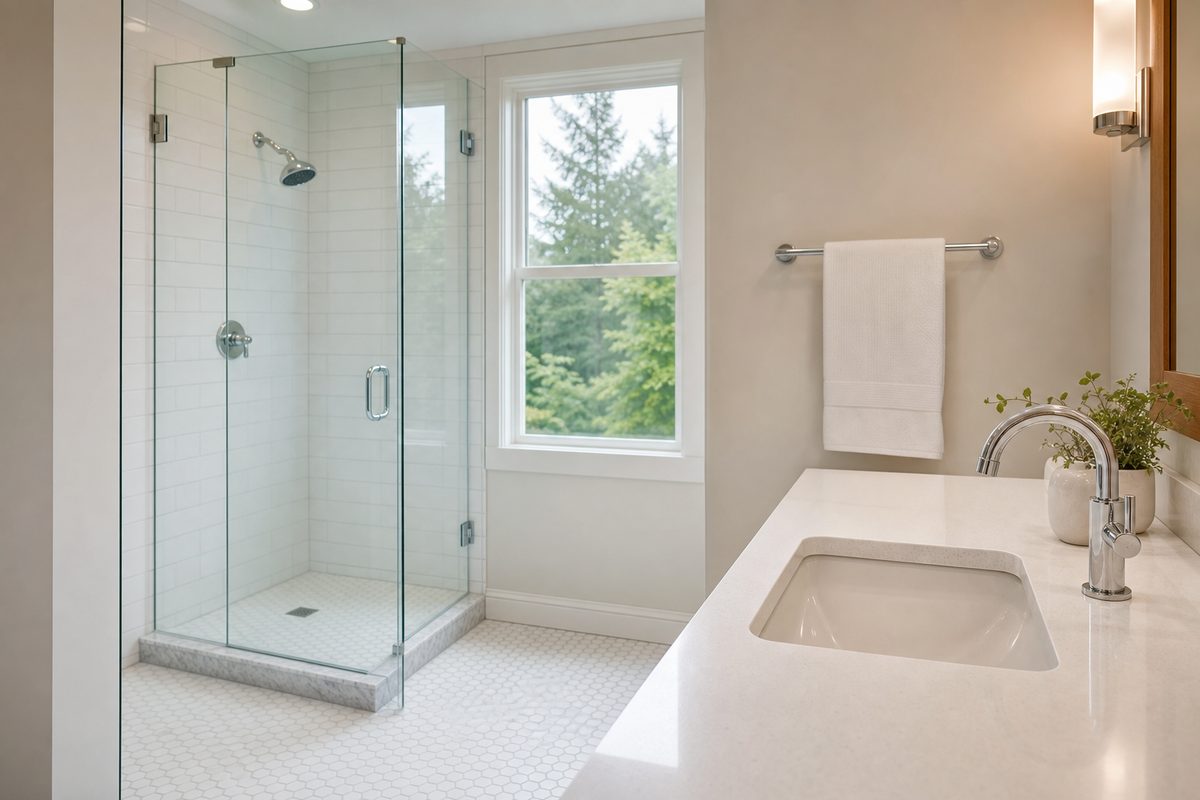
When the harsh product is the right answer
Being sensible about this cuts both ways. There are jobs where a gentler product is not the responsible choice, and disinfecting is the clearest case. Cleaning and disinfecting are different tasks: cleaning removes soil, disinfecting kills pathogens, and most of the time cleaning is all a home needs. But after a stomach bug moves through the house, or on a cutting board that held raw chicken, you want a product actually registered to kill what you are worried about, used exactly as the label says. That includes the contact time, the step everyone skips: a disinfectant has to stay wet on the surface for the minutes the label specifies. Spray and immediately wipe, and you have cleaned the surface without disinfecting it.
Vinegar is not a disinfectant at household strength. It is a fine everyday cleaner and an excellent descaler, and it is not what you use after norovirus. Knowing that distinction is part of choosing safe cleaning products for your home well, rather than just choosing gentle ones.
The other honest exception is mold on hard surfaces and heavy bathroom biofilm. Use the stronger product alone, ventilate hard, wear gloves, and go back to soap and water tomorrow. Reserving harsh chemistry for the jobs that need it is the goal. Never using it is not.
That is how our own kit works: a mild all-purpose product for most surfaces, an acid and some patience for scale, pH-neutral on stone, anything stronger only for a specific reason. The rest is sequence, top to bottom, dry work before wet, fresh cloths often enough that we remove soil instead of relocating it, laid out room by room in our deep cleaning checklist for Spokane homes.
Questions we get asked in the kitchen
Are natural cleaning products actually safer?
Sometimes, and the label alone will not tell you. “Natural,” “green,” and “non-toxic” are unregulated marketing terms with no standard behind them. Judge a product by its ingredient list, its hazard signal word, and whether it carries a reviewed certification such as EPA Safer Choice. Plenty of plant-derived ingredients are genuine irritants.
Do safer cleaning products actually disinfect?
Not usually, and most of the time that is fine, because routine cleaning removes soil rather than killing germs. When you do need to disinfect, after illness in the house or raw meat on a surface, use a product registered as a disinfectant and follow the label’s contact time. Vinegar is not a disinfectant at household concentrations.
What cleaning products should never be mixed?
Never mix bleach with ammonia, which produces chloramine gas, and never mix bleach with vinegar or any other acid, which releases chlorine gas. Avoid combining products generally, since cleaners are formulated to work alone. If a surface needs a second product, rinse the first one off first.
What should you not clean with vinegar?
Keep vinegar off natural stone: marble, granite, limestone, travertine, and slate all etch permanently when acid sits on them. Skip it on unsealed grout, cast iron, and waxed or oiled wood as well. It is excellent on glass and mineral scale, which in Spokane is most of what it is for.
Are essential oils safe to use for cleaning around pets?
Not reliably. Tea tree oil is toxic to both cats and dogs, and cats in particular process many common essential oils poorly. Plant-derived does not mean animal-safe, so if you have pets, plain unscented products are the simpler and safer default.
The short version
Read the back of the bottle. Look for the Safer Choice mark and a mild signal word. Keep the product list short and the stack of cloths tall. Use an acid on our hard water and never on stone. Bring out the strong product only for the job that needs it, then open a window and put it away.
If you would rather hand the whole question off, that is a reasonable answer too. We have been doing this in Spokane and the surrounding area since 2002, and our regular house cleaning is built around exactly this approach: careful method, a short product list, and real attention to what each surface in your home can take. Tell us about your home and we will send a written estimate within a business day, with a free in-home consultation if you would like one.